

Blog
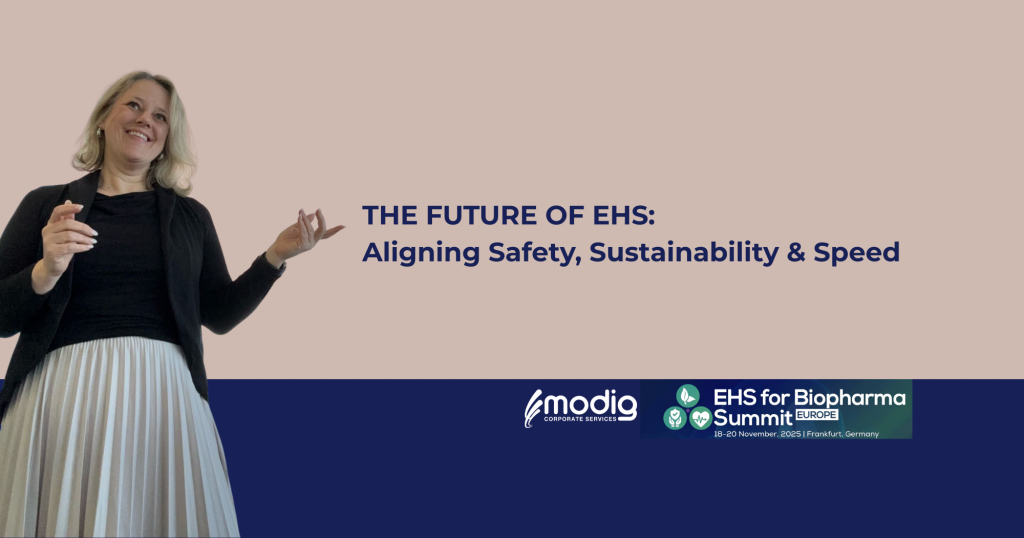
The Future Of EHS: Aligning Safety, Sustainability & Speed
Sep
This November, Hanson Wade will host one of the most important gatherings for the biopharma industry the EHS for Biopharma Summit Europe, (18-20 November 2025). As a partner, Modig Corporate Services Ltd. is proud to support the three day programme, that brings together thought leaders, innovators, and practitioners to shape the future of Environmental, Health & Safety (EHS).
One of the themes that particularly resonates with us and is set to be explored in the summit’s opening workshop is the idea that when safety, sustainability, and speed are treated not as trade-offs but as mutually reinforcing priorities, real transformation becomes possible.
This shift in mindset is part of a wider evolution, one where EHS is no longer just about compliance, but contribution.
From Compliance to Contribution
Today, organisations are being reshaped by AI, automation, and leaner operating models. At the same time, pressure to deliver on ambitious sustainability targets means teams are being asked to do more with less. In this environment, EHS is no longer just a compliance function it is a strategic partner in transformation.
The organisations leading the way are the ones inviting EHS into the room early, aligning safety goals with efficiency and ESG strategy, and shaping systems that work better for both people and performance.
But not every organisation is taking this approach and the cost of overlooking EHS can be high.
Risks Of Bypassing EHS
Let’s be honest, when transformation programmes focus solely on speed and savings, unintended consequences can follow:
- Risky gaps emerging in fast moving, AI driven processes
- Culture erosion during restructuring and headcount shifts
- Sustainability slipping down the priority list
- Teams overstretched, leaving little time to learn, adapt, or raise concerns
Continuous manufacturing and process optimisation are reshaping the industry but the true gains come when efficiency is balanced with safety and sustainability. When EHS is part of the design, productivity improvements don’t come at the cost of risk or resilience.
The answer isn’t to slow down, it’s to transform the way we align safety, sustainability, and speed, so each reinforces the other.
Unlocking Value Through Alignment
Real transformation happens when EHS, operations, and sustainability are not three but one conversation. That means:
- Shared KPIs and governance
- Automation that removes or reduces risk, not just human headcount
- Behavioural insights driving safer decision making, reducing risky behaviours
- Leaders modelling safety as a lived value, not a dusty written policy
Why Leadership is the Game Changer
Technology can accelerate transformation, but leadership determines whether it succeeds. The organisations that thrive are those where leaders:
- Show up visibly and consistently for safety
- Foster psychological safety and encourage reporting
- Build feedback loops that connect the lab, the production line, and the boardroom
- Break down silos so EHS is embedded in daily decision making
We’re really looking forward to hearing from Andrew King and Laurent Seurin from AstraZeneca as they open the summit with a deep dive into challenges and opportunities surrounding AI, automation and the balance of safety and sustainability.
We believe this session will challenge us all to consider how EHS can be a driver of value not a constraint in the era of AI and continuous manufacturing.
Next in our series: Cultivating Future Ready Leaders, where we’ll explore the qualities and actions that set great EHS leaders apart. We’d love to hear your perspective, What does future ready EHS leadership mean to you? And if you are attending in Frankfurt, let’s connect!